Search Results
Search this site
22 results found with an empty search
- 15 tips for coping with hot weather
I have Postural tachycardia syndrome (PoTS) (see more info at https://www.potsuk.org/ ) - which makes me unable to cope with heat. I don't mean I feel hot and sticky. I mean that I become increasingly unable to think clearly, lose coordination (causing slurred speech as well as difficulty keeping my balance or carrying out any physical tasks), and can lose consciousness. So managing my temperature is a really important part of managing my symptoms. Here are some tips and tricks I use for coping with hot weather, depending on the circumstances. layers. Thin layers so I can adjust to draughts etc. My preferred is light scarves so I can protect my skin from cold draughts without overheating. water spray - spraying water on the wrists, inside the elbows, and neck. staying hydrated - upping both liquid and salt intake cooling vest - this is a vest thing with pockets that hold 'phase change cooling packs'. Phase change packs are like ice-packs, but they 'freeze' at 16 degrees C (or other specified temperature) instead of 0 (freezing). And stay at that temperature until melted (which takes 2-3 hours) Mine is from https://www.ezcooldown.com/ Seriously amazing. (note: this company is in Germany, so you won't pay VAT on the shop, but will have to pay import duties and taxes to customs. I tried a UK equivalent but the quality was poor - the vest turned everything it touched black - even after several washes, and I had to return it.) sitting with feet in cold water. having a damp cloth to put on neck in longer heatwaves - spending the worst few days in an air conditioned hotel small meals - cold food only. (the oven and hob in my house are not allowed to be switched on in hot weather) keeping curtains closed on windows that catch the sun to keep the heat out - until the sun goes down and it cools outside then opening all the curtains, and windows (and doors if I can) to let the cool in. fans visiting the freezer/chilled aisle in a supermarket spending the hottest time of the day somewhere air conditioned (e.g. office building, cafe with air con, vehicle with air con) spending minimal time upright during the hottest part of the day (this is related to PoTS - it reduces my overall level of symptoms, and so reduces the strain and shortens the recovery time) becoming more nocturnal in major heatwaves. For example, I might get up for breakfast at about 6 - function for a few hours then back to bed and do absolutely nothing except try and stay cool, hydrated, and rested, from late morning until evening. It's not unusual for me to eat dinner at midnight in a major heatwave - then go to bed about 1 or 2am. Staying in the shade (or in the house if that's cooler) I also avoid speaking as much as I can during heatwaves (another trigger for my PoTS symptoms - my body really doesn't do well with other symptom triggers added to the heat) - so particular cards also tend to get much more use if I interact with anyone during a heatwave! If you have any strategies I haven't mentioned, but that you find helpful, please share them in the comments!
- The 'post-stressor fatigue crash'
You know that thing where you have a busy or stressful patch, and seem to cope with it fine...until the stressor stops - and then it all hits at once? That. With chronic illnesses/disabilities, it's easy to understand how overdoing it can give us a fatigue crash, and acute stressors can worsen symptoms. But it's not so obvious that a stressor that we've been apparently coping ok with can cause an avalanche of symptoms when it is removed. I am SO glad that I knew my body does this otherwise I'd have been totally panicked by my symptoms this week! My house has been on the market for several months - meaning paperwork and phone-calls, keeping the house ridiculously tidy, and having people round to view it at times that work for them. It's been a huge energy drain. I've done my absolute best to pace - taking extra half-day breaks when my rest days got interrupted, adjusting the times of my usual activities (and reducing some) to maximise coping. And being as relaxed as I could about it - when it's the right time, my house will sell. At times I curled up and cried with the overwhelm and exhaustion and unrelenting-ness of it. But I'd got better at coping and managing the conflicting demands on my time. Then on Monday morning I had a viewing, and they were definitely going to put an offer in. So still various steps to get through, but mentally...my brain just went "Awesome, the 'I need to sell the house' stressor is gone. Now I can recharge." Oh. My. Word. I could barely keep my eyes open for the rest of Monday. And I was floppy, uncoordinated, and unable to concentrate for days. I did almost nothing except eat, and sleep, and maybe a total of an hour of essential tasks spread throughout the day for 3 days. I find it wryly amusing that I felt kinda nice and relaxed. (and obviously very happy to have sold) But also completely unable to do stuff. It was as if my body and brain have decided I'm on holiday, and in a safe space. Given me a forced time out. If I really tried, I could probably force myself to do stuff, but I decided I need this break. Especially as the next phases of moving will be challenging too. So I've been wholeheartedly agreeing with my body and my brain every time I felt like I needed a rest. There's been a LOT of watching the red kites outside my window, and enjoying the mass or roses on my trellis. And Audiobooks in my better patches. And now: I'm starting to emerge. This post-stressor fatigue crash will pass, with gentleness and time.
- How to use the keyring cards
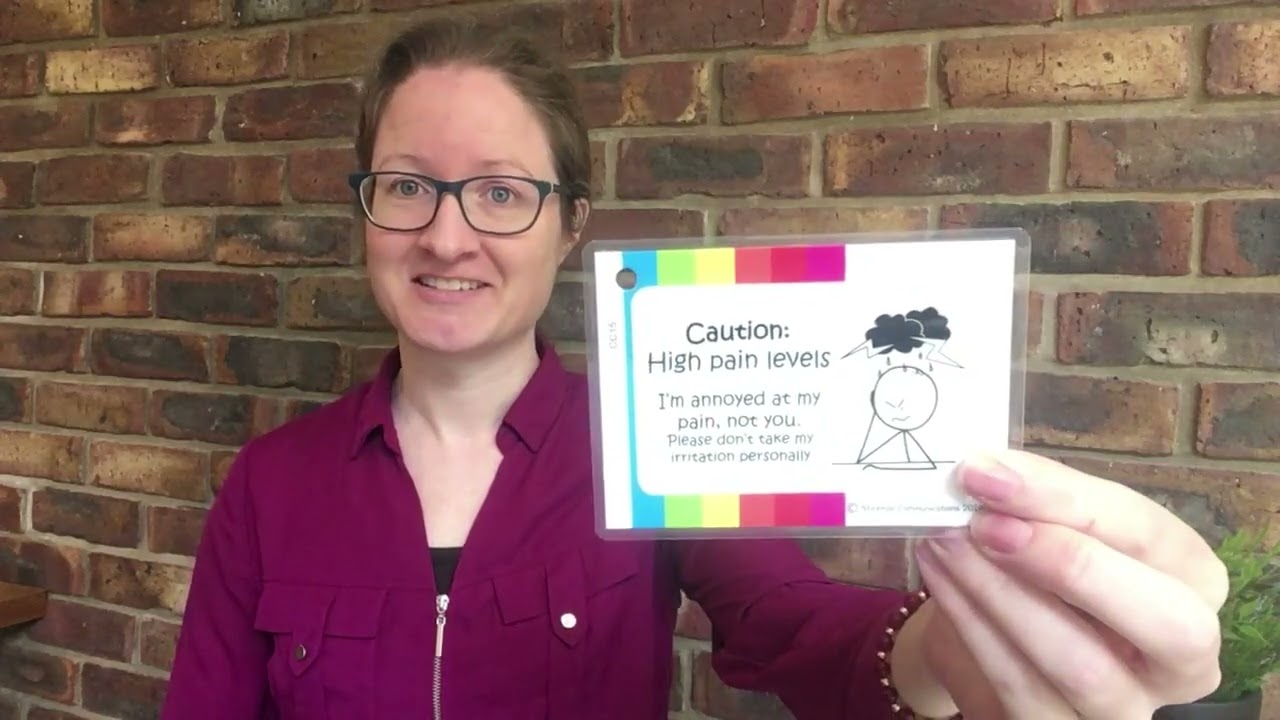
There are many different ways that people use our keyring cards. Here are a few: (click on the arrow at the side to open the detail) Answering 'What's wrong with you' Whether asked by medical professionals, family, friends or colleagues, there are times we want the people around us to know about our differences - but at the same time, we don't want to spend all our time repeatedly explaining it. The keyring cards can solve this issue by explaining it for us. And yes, health-care professionals seem to really like these cards. We have had several paramedics, A & E, and nursing staff contact us saying how much easier the cards have made their job. Helping someone understand how you function/what your normal is. When a condition means you may do things differently and/or have different limitations to the 'average' person, being able to give people who you will be spending time with (like friends, family and colleagues) an overview of your normal is very helpful. Showing them your pack of cards means they can understand - and will be able to react more appropriately and not fuss when your various differences become relevant. They can also help ensure that expectations are realistic and reduce the number of misunderstandings. For example if they know you wear headphones for a medical condition, they are less likely to misinterpret headpones as 'ignoring' or 'rude'. Or if they've read the fatigue card they are less likely to assume you are being lazy when you need to take a break. The colour, light-hearted tone and stickman images make it easier for people to process and accept the information given in a way that a verbal explanation rarely achieves. Explaining or describing your symptom level or key need, here and now. Cards can also provide a great way to convey vital information in specific situations, especially where it is hard to find the right way to explain it - whether because it's hard for you to speak or find the right words, or it is something the other person may find hard to understand or accept. If I have a particularly problematic symptom - for example, if I'm struggling with speech, I will often wear the cards on a lanyard with the applicable 'non verbal' or 'difficulty speaking' at the front so I can explain quickly and effectively. Other times I might put a card on the table next to me - for example the recharging card, or the one saying I can't cope with people, or the one saying I'm concentrating - please don't disturb. So that anyone who comes up to me gets the information they need without me having to interact with them at all. This short video gives an overview of some of the ways people use the stickman communications keyring cards.
- Variable disabilities and the constant flow of decisions needed.
One thing many people don't realise about variable disabilities is the need for constant decisions - weighing up symptom levels against task requirements, and task importance, and then taking into account all the possible ways of doing the task, and finally deciding: whether to do it, when to do it, and how to do it. Again. And again. And again. It's exhausting. And it's why sometimes I get to the point of not being able to make standard decisions (like choosing an item in a shop, or what to have for dinner). It's like my brain is all decision-ed out by the constant stream of disability related decisions it has to deal with every day. Anyway: Yesterday I got a decision wrong. And had an extra load of extra cleaning to do as a result. I considered my pain levels, fatigue, joint stability, and whether I felt close to fainting - and all were within limits that meant I should be able to unpack the grocery delivery from delivery crate to the side next to it without my wheelchair. It turned out, I forgot to check in with my coordination levels - and they were appalling. No way should I have tried a task needing lots of gripping and control, while standing! The result: a large pot of yoghurt liberally spattering the floor and cupboards. Note: I don't feel the least bit guilty or any 'I should have chosen differently!' self blame. Because I made the decision as well as I could at the time. And it's ok to not always get it right. Things like this are just part of my conditions - and it's a constant learning curve trying to manage them.. I'm just sharing this as I thought it was a really good example of the constant need for strategic planning and decision making, just to get through a basic day as a person with variable symptoms.
- When little things are big things
In my experience, disability often means compromise. It means accepting there are some things I can't do. Or, more often, that I can only manage one of multiple things - and so I constantly prioritise and many things just don't happen. And it is almost always the practical that has to be prioritised over the pretty. Often these are 'little things'. In the wider scheme of things it's not a big deal. For me one of those little things is my hair. I can't do anything more than the absolute basics with my hair. Holding my hands above shoulder height worsens my PoTS - putting my arms right up in order to do my hair is even worse - and might only be possible for a few seconds at a time - so ponytail it is. And I've just got used to that limitation. The physical cost of doing anything more is so high it's just not a sustainable option. Anyway, last week I asked my PA to do my hair in 2 french braids. I can't do it myself, but it's a really good hairstyle for me because I can lie on my back or my side really comfortably - it won't annoy my neck, or have lumps that bruise my scalp. Plus, it usually stays in place for a couple of days. And I like how it looks. So I thoroughly enjoyed actually having an actual hairstyle for 2 1/2 days then decided it had reached the 'too messy' stage and I took it out... It turns out my not-quite-straight-not-quite-curly hair really liked the wave the braids made, and 2 days on, it's still got that curly bounce! So I've now had 4 days of nice hair, from minimal energy use! 10/10. Would highly recommend. Will do again. It's only a little thing, but for me, it's kinda big. And really lovely.
- Disabled people, self management, and 'being controlling'
I sometimes hear disabled people being spoken of as demanding or controlling. And it never sits well with me. Of course some individuals might be being unreasonably demanding, but most of us....just aren't. Only I couldn't see how to put this into words. My current situation however has given me a really practical example of why a disabled person asking for specific things, specific timings etc may not actually be being 'demanding'. So: I have a hypermobility syndrome, autonomic dysfunction, and some kind of neurodivergence. My usual self management and pacing strategies rely on responding to my body's needs in order to maintain as good a level of functioning as possible. So if I'm doing something and I get my body's warning signals - being more uncoordinated or floppy, or I feel sick or dizzy, or increased pain, or decreased concentration, or increase sensory sensitivity, or wanting to cry etc - then I respond to those symptoms: resting, moving, eating, drinking, changing position, adjusting temperature or noise levels, postponing or changing tasks, adjusting priorities. etc. This is a constant process throughout the day. All these adaptations mean that overall I can do a lot more than if I'd tried to 'push through' and it has also improved my overall health long-term. The thing is: this approach requires me to have complete control over my schedule, and a lot of control over my environment. Not because I like or want control, but because I need it in order to maintain my ability to function. Uncontrollable things (like appointments, or heatwaves) are planned around with great care. You could say that when there is a thing out side of my control, I need greater control of everything around it in order to maintain my health. However: I am currently in the process of moving house. This means: estate agent visits, potential buyer visits, telephone calls, paperwork. All against a background of 'My entire house must be completely clean and tidy for every viewing, and I must be out of the house for the duration' It's all on other people's schedule, and I have very little control over the timings. The effect: I can't manage my health as I usually do. Planned rest periods are interrupted, additional tasks have to be done whether I'm well enough or not and the result is that I've noticed a drop in my overall functioning. Because I do not currently have the consistent level of control over my day that I rely on to manage my health. It's only for a short time - until I sell the house, but it's really opened my eyes to how much difference having control makes. What this has taught me is that the 'control' I usually operate with isn't me being controlling because I 'want' control - it's me doing my best to maintain the health I have, and without it I will, quite simply, get worse. Quickly. So when you next interact with a disabled person who is 'being controlling or demanding' - please step back and look again, because maybe in reality all they are asking for is the basics that will allow them to function, to be part of society, and to not get worse. Am I saying that the disabled persons 'demands' should always, without question, be followed? No. Compromise is often needed. And there might even turn out to be different ways to meet the need that will work even better than the original suggestion. But I am saying that if a request can't be met, or a compromise may be needed: ALWAYS approach it from the perspective that they are making that request for a very good reason.. This way, if the 'demand' (or more accurately: need) can't be met in the way initially requested, then you can work together to create alternative strategies, extra support, etc that will meet that need in a different way - and in doing so maximise symptom/health management, and therefore also maximise their ability to join in. (Note: In my experience this also applies to things like emotional and sensory regulation, not just pain and fatigue).
- A pacing 'holiday day'
With chronic illness and disability it can be SO good to sometimes do less than your max for no particular reason*, and do things that are nice and feed your soul instead of all the never ending essentials. I call these: pacing 'holiday' days. I create a really quiet, low demand schedule, removing all 'have to'. And then do something nice that lifts my soul and has no 'ought to' attached to it. It's very different from resting when "it's essential and I have no other option that doesn't involve crash and burn". That requires huge amounts of self discipline and work. This involves giving myself permission to do whatever I feel like doing (within reason!) - and it doesn't have to be sustainable. Holiday days help to: - Top up my energy reserves. - Increase - or stabilise - my baseline capacity a bit. - Act as a 'fire break' to stop long term overdoing from escalating into a significant decline in health. - Really helps my mental health and overall perspective. Today it's sunny. And I managed to have a 'holiday' morning. I sat in the sun, wrapped up all snug and soft, listening to an audiobook and doing cross-stitch. Even though I had enough energy to do more . It was exactly what I needed. I love seeing the pattern grow. And I love being outside in winter sun. It was like a release valve in my head being opened and letting out the tension. I then had a really productive meeting for a couple of hours in the afternoon - before going back to 'holiday' mode. I could have done more. But I didn't. And it was totally the right decision. *Note: This strategy won't work for everyone. For people with severe levels of fatigue, the basics of living (eating, breathing, going to the toilet) can take all available energy, making this kind of day incredibly difficult (sometimes impossible) to achieve.
- How to use the Pacing Fridge Magnets
Pacing to manage limited energy involves switching between activities that are challenging and ones which allow us to recharge from that activity, and adapting how we do things so they better suit our abilities. (Check out the pacing category for more information on pacing) We created the Pacing Fridge Magnets set It helps us to achieve this balance between looking after our body and mind while still getting things done. 1 - Gently separate the individual small rectangular magnets from the combined sheet they arrive in. The fridge magnets - separated from their sheet, into individual magnets 2 - Place them on a suitable metal surface - such as a fridge door or a magnetic whiteboard. 3 - Spread out the 'Time' magnets in the right order to give a timeline for your schedule. 4 - Write the tasks you want to complete during the day on the relevant 'Task' magnets. Red for 'challenging stuff' - this can be either physically challenging or mentally challenging. Both can be very draining and therefore recovery time will be needed. Orange for 'OK stuff' - Not as hard as the red, but still uses up energy, so needs to be treated with respect. Green for 'Easy stuff' - which can help recharge. Recharging activities can be aimed at regaining physical or mental energy. They can be active - like going for a walk, or resting - like listening to music, or even just something very different from what you've just been doing and which has used up lots of a specific type of energy. Whatever helps you recharge in that context. (It can help to complete the green squares last - when you have scheduled the rest of your day, then tailor the 'Easy stuff' to balance out the red and orange tasks you have.) Purple for meals and snacks (don't forget to factor in food prep - especially if that's a challenging activity for you - in which case it may need a red square all to itself!) and Blue for stretching, exercise and relaxation - all of which are essential parts to being as healthy as possible. Remember, exercise can mean anything from sitting up using core muscles for a few seconds to running marathons! What you put on the squares should reflect your reality and needs. When writing the tasks, also think about how you do things. Can you do a challenging thing in an easier way so it becomes less challenging? - like sitting down to empty the washing machine. (see also our pacing 'handy hints' poster and ‘ Pocket book of Pacing ’ fo r more tips on pacing well.) 5 - Once you've written your tasks, put the magnets into order to create your schedule. 6 - See if you honestly think it's a sensible plan. It should contain a good mix of all the colours. If, having seen the schedule, you think it needs changing, simply move things around until it works for you. Having a 'for tomorrow' section of the board is a good idea - so if a task doesn't fit in today's pacing schedule, you aren't deleting it, just moving it aside for now. 7 - Follow your plan! Using a timer or alarm to remind you when to change activities can really help, so you don't accidentally get too involved to notice how long you've been doing something, and not notice until symptoms get so bad they stop you in your tracks. 8 - Move magnets and tasks round if things change For example, if unplanned things happen, or your symptoms are better or worse than you expected. General care instructions for magnets Whenever you need to change the task on a magnet, simply wipe it off with the eraser supplied, or a soft tissue. If this doesn't work, write over the remaining marks with the drywipe pen provided, and then rub them out again - the new pen will soften the old pen marks and remove it easily. Only use drywipe pens on the magnets. Do not get the magnets wet.
- My 4 top tips for pacing laptop time
Setting up this website has, unsurprisingly, meant a lot of time on the laptop. For me this risks aggravating 2 main issues: Fatigue - from both concentration, and from sitting up and aggravating my #POTS symptoms. Joint pain - due to my #Hypermobility, from positions that strain a particular joint, or from repeated movements (like typing, or mouse use) To help manage these symptoms, I pace my laptop time using the following strategies: (Note: these are what work for me, what works for you might be different, I'm just sharing these because they might help someone.) My home desk is set up with a supportive chair, and a reasonable arm position (not perfect, but better than nothing). Have my spare room set up so that I can work from lying down, with my joints supported and in a position that means I don't strain my neck to look at the screen, (a laptray with a theraband holding my laptop in place works a treat) Timers. A half hour timer if I'm sitting up, and an hour timer if I'm lying down - then the timer acts as a prompt to move about, stretch, relax my brain, get my blood moving again, snack, rehydrate - or whatever I need to do. Even if it's just a 2 minute break it helps. For me the one thing it is essential that I do during these breaks is change position - whether it's simply stretching out my legs, or full on getting up and doing physio - or something in between. (I have these cube timers - when it's on, to set it you just place it with the right number face up.) Unplugging the laptop (and on a good day, leaving the charger in another room). This means that there is a fail-safe stop point when the battery runs out. I have a tendency to get really engrossed in projects and then completely to forget to eat and drink - let alone pace. So having this fail-safe means that although I might overdo it up to a point, it won't be nearly as bad as if my laptop let me continue indefinitely!
- Welcome!
Welcome to our brand new website. It's been a bit of a pacing marathon - with a 30 minute timer being employed regularly for the past 2 weeks to stop me sitting for too long and completely messing up my symptoms. It's worked though. I've published the new website without having burnt out, and have only aggravated my symptoms within what I consider acceptable limits. (Having said that, I think dinner tonight may be a takeaway. Zero-prep, comfort/relief food is needed!) It's very different to the old site but hopefully easier to find things on -with a few more clicks, but less brain required. If you create an account you can do useful things like: choose whether to be notified when blog posts are published, create a wishlist, save your address etc. If you were signed up to our old enews, you don't need to sign up again. We'll import that list in a few days when I'm confident any major issues have been ironed out. If you weren't signed up and want to be - just go to the footer and you can subscribe to emails there. (Once subscribed, you can unsubscribe using the unsubscribe button on the bottom of any enews sent from this site) And that's all my brain has for now! I'm off to have a rest-evening. Enjoy your browsing! Hannah